
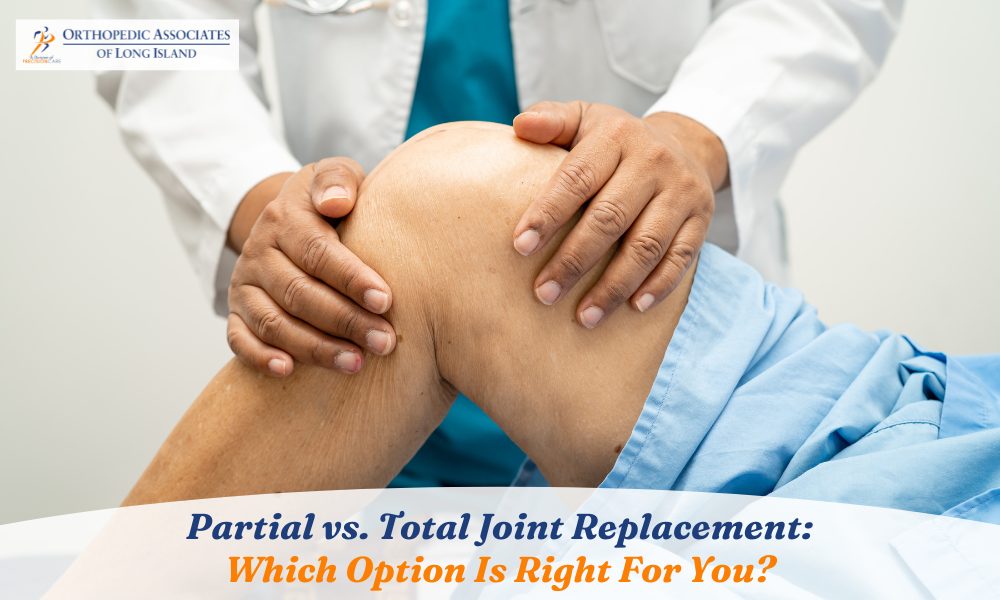
Joint pain can significantly impact your daily life, limiting mobility, reducing independence, and affecting overall well-being. When conservative treatments like medication, physical therapy, or injections no longer provide relief, joint replacement surgery may be the next step. At Orthopedic Associates of Long Island, we guide patients through understanding their options—specifically, partial versus total joint replacement—to help you make informed decisions tailored to your needs.
Understanding Partial and Total Joint Replacement
Partial joint replacement, also called unicompartmental arthroplasty, involves replacing only the damaged portion of a joint while preserving healthy bone, cartilage, and ligaments. This approach is commonly used for knees and hips where degeneration is limited to one section of the joint. By maintaining more of the natural joint structure, partial replacement often allows for quicker recovery, smaller incisions, and more natural movement post-surgery.
Total joint replacement, in contrast, involves replacing the entire joint with a prosthetic implant. This is typically recommended when joint damage is more widespread or involves multiple areas of the joint. Total replacement can provide long-lasting pain relief and restore full function, though the procedure may require a longer recovery period compared to a partial replacement.
Why the Right Choice Matters
Selecting the best surgical option depends on several factors, including the extent of joint damage, age, activity level, and overall health. Partial replacement is often ideal for younger, active patients with localized joint deterioration, as it preserves more bone and allows for a faster return to daily activities. Total replacement may be more appropriate for patients with advanced arthritis, deformities, or previous injuries affecting multiple parts of the joint.
Key Benefits and Considerations
Partial Joint Replacement:
-
Preserves healthy bone and tissue
-
Smaller incision and shorter recovery time
-
More natural joint motion post-surgery
-
May not be suitable for widespread joint damage
Total Joint Replacement:
-
Addresses extensive joint degeneration
-
Provides long-term pain relief and improved function
-
Prosthetic implants designed for durability
-
Longer recovery period and potential need for physical therapy
Making the Decision
At Orthopedic Associates of Long Island, our surgeons take a personalized approach, using advanced imaging and thorough evaluations to determine which option best meets your needs. We discuss the risks, benefits, and expected outcomes of each procedure so patients can make confident decisions. Recovery plans are tailored to support healing, restore strength, and get patients back to the activities they enjoy.
Tips for a Successful Joint Replacement Recovery
-
Follow your surgeon’s rehabilitation and physical therapy plan
-
Maintain a healthy weight to reduce stress on the joint
-
Engage in low-impact activities like swimming, cycling, or walking
-
Monitor for signs of infection, swelling, or unusual pain and report promptly
-
Pace your return to high-impact or strenuous activity gradually
Whether you’re considering partial or total joint replacement, the right surgical plan can dramatically improve quality of life. Our team at Orthopedic Associates of Long Island is dedicated to helping patients regain mobility, reduce pain, and enjoy an active, fulfilling lifestyle. By choosing the right procedure and following a personalized recovery plan, you can take confident steps toward long-term joint health.
For individuals weighing surgical options, temporary pain relief options like cortisone injections may help control symptoms while determining whether partial or total joint replacement is necessary.