Shockwave Therapy on Long Island (EPAT)
Shockwave therapy uses acoustic pressure waves to stimulate healing in tendons, ligaments, and muscles that haven’t responded to rest, therapy, or injections. Treatment takes five to ten minutes in the office, requires no anesthesia or incisions, and you walk out and resume normal activity the same day.
Orthopedic Associates of Long Island offers CuraMedix Extracorporeal Pulse Activation Technology (EPAT), a radial pressure wave system, at locations across Suffolk County. It’s most often used for chronic tendon problems—plantar fasciitis, Achilles tendinopathy, tennis elbow—when conventional treatment has stalled and surgery is the alternative.
Conditions Shockwave Therapy Treats
Foot and Ankle
- Plantar fasciitis and chronic heel pain — the most common indication, and where the evidence is strongest
- Achilles tendinopathy, both midportion and insertional
- Posterior tibial tendinopathy
- Morton’s neuroma
- Heel spurs
Elbow
- Tennis elbow (lateral epicondylitis)
- Golfer’s elbow (medial epicondylitis)
Knee and Lower Leg
- Patellar tendinopathy, or jumper’s knee
- Shin splints (medial tibial stress syndrome)
- IT band syndrome
- Pes anserine bursitis
Shoulder
- Rotator cuff tendinopathy
- Calcific tendinitis of the shoulder
- Chronic shoulder impingement pain
Hip
- Greater trochanteric pain syndrome and hip bursitis
- Gluteal tendinopathy
- Hamstring origin tendinopathy
Other
- Delayed-healing stress fractures
- Chronic muscle strains
- Scar tissue and adhesions limiting motion.
How It Works
Chronic tendon problems aren’t really inflammation — despite the “-itis” in names like tendinitis. After months of symptoms, the tissue has usually entered a degenerative state with disorganized collagen, poor blood supply, and a stalled healing response. That’s why rest alone often fails: the body has essentially stopped trying to repair the area.
Shockwave therapy restarts that process. The acoustic pulses create controlled microtrauma in the tissue, which triggers a fresh inflammatory and healing cascade. The mechanisms understood to contribute include:
- Increased blood flow through the formation of new microvessels
- Stimulated cell metabolism and fibroblast activity
- Collagen remodeling, replacing disorganized tissue with better-aligned fibers
- Breakdown of calcific deposits, which is why it works well for calcific shoulder tendinitis
- Reduced pain signaling through effects on local nerve endings
The result builds gradually. Most patients don’t feel better immediately after a session — improvement accumulates over the weeks following the treatment course.
What a Treatment Session Is Like
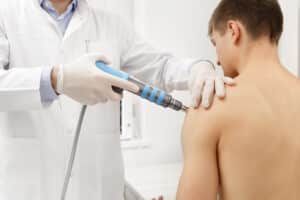
A session takes five to ten minutes. You stay in your regular clothing with the treatment area exposed. Your provider applies ultrasound gel and moves a handpiece over the area while it delivers rapid pulses.
What it feels like: most patients describe a firm tapping or pulsing sensation. It can be uncomfortable over a tender spot, and intensity is dialed up or down based on what you can tolerate. No anesthesia is used, partly because your feedback helps locate the treatment zone precisely.
Afterward: you walk out and go about your day. No boot, wrap, or activity restrictions. Some patients feel mild soreness for a day or two, similar to post-workout ache.
How Many Sessions Will I Need?
Most treatment courses run three to five sessions, spaced about a week apart.
A realistic timeline:
- Sessions 1 to 2: little noticeable change, sometimes temporary soreness
- Session 3: many patients notice their first improvement
- Weeks after the final session: continued gains as tissue remodels
- 6 to 12 weeks post-treatment: full benefit typically assessed
That delayed response catches people off guard. If you finish your last session feeling only somewhat better, that’s expected — the tissue is still rebuilding.
Cost and Insurance Coverage
Most insurance plans do not cover shockwave therapy. Many insurers still classify it as investigational for several indications, so patients typically pay out of pocket.
Because coverage varies by plan and condition, we’ll verify your specific benefits before starting. If it isn’t covered, our staff will give you the full cost of a treatment course up front so you can weigh it against your other options. Nobody should start a multi-session treatment without knowing what it costs.
Some patients find shockwave worthwhile even out of pocket when the alternative is surgery, with its own costs, downtime, and recovery. Others reasonably decide it isn’t. That’s your call to make with complete information.
Who Should Not Have Shockwave Therapy
Shockwave isn’t appropriate for everyone. It’s generally avoided if you:
- Are pregnant
- Have a bleeding or clotting disorder, or take anticoagulant medication.
- Have an active infection at the treatment site.
- Have a tumor or malignancy at the treatment site.
- Have an open growth plate at the site, which applies to some adolescents.
- Have a known blood clot in the area.
- Received a corticosteroid injection at the site recently.
Certain implanted devices and nerve conditions also warrant caution. Your physician will review your full history before recommending treatment.
Possible side effects are usually mild and short-lived: temporary soreness, redness or minor swelling at the site, occasional bruising, and brief numbness or tingling.
Is Shockwave Therapy Right for Me?
It tends to be a good fit when:
- Symptoms have persisted more than three months.
- Physical therapy, rest, stretching, and orthotics haven’t resolved it.
- Injections gave only temporary relief, or you’d rather avoid them.
- You want to avoid or delay surgery.
- You can complete a multi-week course of sessions.
- You have a tendon or fascia problem rather than a structural tear.
It’s less likely to help when:
- The problem is a complete tendon rupture or significant structural tear.
- Pain is coming from advanced joint arthritis rather than soft tissue.
- Symptoms are acute and likely to resolve on their own.
- The underlying diagnosis is uncertain.
That last point matters most. Shockwave is a treatment, not a diagnostic tool. Heel pain can be plantar fasciitis, a stress fracture, nerve entrapment, or referred pain from the spine. Getting the diagnosis right first is what determines whether any treatment works.
Frequently Asked Questions
Does shockwave therapy hurt?
Most patients tolerate it well. Expect a firm tapping sensation with some discomfort over tender areas. Intensity is adjustable, and no anesthesia is needed. Discomfort ends when the session ends.
Most patients tolerate it well. Expect a firm tapping sensation with some discomfort over tender areas. Intensity is adjustable, and no anesthesia is needed. Discomfort ends when the session ends.
How long until shockwave therapy works?
Most patients notice improvement around the third session, with continued gains for six to twelve weeks after the final treatment. It’s a gradual process, not immediate relief.
Most patients notice improvement around the third session, with continued gains for six to twelve weeks after the final treatment. It’s a gradual process, not immediate relief.
Does insurance cover shockwave therapy?
Often not. Many plans consider it investigational for several conditions. We verify your specific coverage before beginning and provide full pricing if you’ll be paying out of pocket.
Often not. Many plans consider it investigational for several conditions. We verify your specific coverage before beginning and provide full pricing if you’ll be paying out of pocket.
How many sessions do I need?
Typically three to five, about a week apart, though your physician will tailor this to your condition and response.
Typically three to five, about a week apart, though your physician will tailor this to your condition and response.
Is shockwave therapy the same as ultrasound therapy?
No. Therapeutic ultrasound delivers sound waves primarily for heating and is much gentler. Shockwave delivers high-energy acoustic pulses intended to create controlled microtrauma and trigger a healing response: different mechanism, different purpose.
No. Therapeutic ultrasound delivers sound waves primarily for heating and is much gentler. Shockwave delivers high-energy acoustic pulses intended to create controlled microtrauma and trigger a healing response: different mechanism, different purpose.
What’s the difference between radial and focused shockwave?
Radial pressure waves, which EPAT uses, spread energy across a broader, shallower area — well suited to plantar fasciitis and superficial tendon problems. Focused shockwave concentrates energy at a specific depth and is used for deeper targets. Both have clinical roles.
Radial pressure waves, which EPAT uses, spread energy across a broader, shallower area — well suited to plantar fasciitis and superficial tendon problems. Focused shockwave concentrates energy at a specific depth and is used for deeper targets. Both have clinical roles.
Can shockwave therapy help me avoid surgery?
For some patients with chronic tendinopathy, yes. It’s most often used precisely at that decision point, after conservative care has failed but before considering an operation. It won’t repair a complete tear.
For some patients with chronic tendinopathy, yes. It’s most often used precisely at that decision point, after conservative care has failed but before considering an operation. It won’t repair a complete tear.
Can I exercise after a session?
Light activity is fine immediately. Your physician may ask you to reduce high-impact loading of the treated tendon during the course so the tissue can remodel. You’ll get specific guidance.
Light activity is fine immediately. Your physician may ask you to reduce high-impact loading of the treated tendon during the course so the tissue can remodel. You’ll get specific guidance.
Is shockwave therapy FDA-cleared?
Extracorporeal shockwave devices are FDA-cleared for specific orthopedic indications. Your physician can confirm the clearance status for your particular condition.
Extracorporeal shockwave devices are FDA-cleared for specific orthopedic indications. Your physician can confirm the clearance status for your particular condition.
Can I have shockwave if I’ve had cortisone injections?
Usually yes, though not immediately after. Corticosteroids temporarily suppress the healing response that shockwave is meant to stimulate, so timing is coordinated deliberately.
Usually yes, though not immediately after. Corticosteroids temporarily suppress the healing response that shockwave is meant to stimulate, so timing is coordinated deliberately.
Shockwave Therapy at Our Long Island Offices
At Orthopedic Associates of Long Island, shockwave therapy is one option within a full musculoskeletal practice — not a standalone service. That matters, because the value of shockwave depends entirely on whether it’s the right treatment for your actual diagnosis.
Our physicians examine you, image when needed, confirm what’s causing your pain, and then recommend shockwave only when it genuinely fits. If physical therapy, an injection, an orthotic, or surgery is the better answer, we’ll tell you that instead.
We treat patients at our East Setauket, Commack, Patchogue, Riverhead, West Babylon, and Southampton offices, serving Suffolk County and eastern Nassau County.
Call 631-689-6698 to schedule an evaluation and find out whether shockwave therapy makes sense for your condition.